
Toilet Training an Autistic Child: A Flexible Step-by-Step Approach
9 min read
Toilet training an autistic child can take patience, consistency and a willingness to adapt the approach to the child's individual needs. What works for one child may not work for another, and the right strategy can change as a child becomes more comfortable with the toilet routine.
For many autistic children, visual supports, predictable routines and positive reinforcement can make toilet training easier to understand. A simple token system can also help children see their progress and understand what happens next.
The Wear Your Wins T-shirt can become part of that system. Rather than being the reward itself, the T-shirt can serve as a visible reminder that every step toward independence is a win.
This article describes one way parents and caregivers can structure toilet training using visual supports, tokens and gradually changing rewards.
Important: Every child is different. This approach is intended as a practical idea for parents and caregivers, not as medical or behavioral treatment. If toilet training is particularly difficult or your child has medical, sensory or behavioral concerns, consider working with a qualified healthcare or behavioral professional.
Why Can Toilet Training Be Challenging for Autistic Children?
Toilet training can be more difficult for some autistic children for several reasons. A child may have difficulty understanding a new routine, communicating that they need to use the bathroom, recognizing the sensations associated with needing to go, or moving away from a familiar diaper or pull-up routine.
Communication can be particularly important. A child who has limited verbal communication may not be able to answer a question such as, "Do you need to go to the bathroom?"
This is where a visual toilet-training routine can be helpful. Instead of expecting a child to understand one large task — "Use the toilet" — the process can be broken down into smaller, understandable steps.
Start With a Visual Toilet-Training Schedule
Before introducing a token system, create a simple visual sequence showing what happens in the bathroom.
For example: Pull pants down → Sit on the potty → Wipe → Pull pants up → Wash hands → WIN!
The exact steps should be adapted to the child's developmental level. Some children may understand "pants down" as one step. Others may need the task broken down further, such as pulling the shirt up, undoing the pants and pulling the pants down.
The goal isn't to make the visual schedule complicated. The goal is to make the routine predictable and understandable.
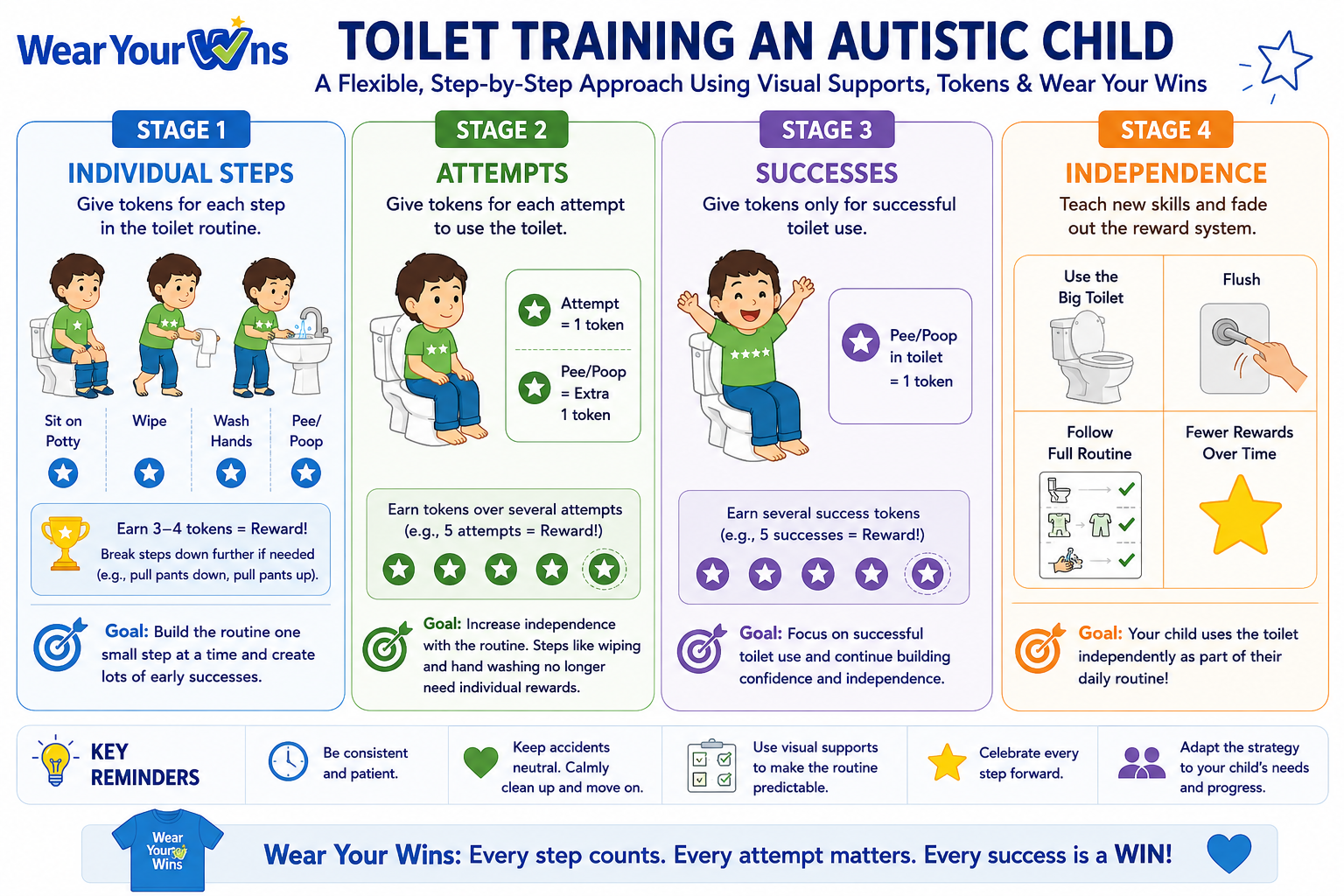
Stage 1: Give Tokens for Individual Steps
When a child is just beginning toilet training, expecting them to complete the entire routine before receiving reinforcement may be too difficult.
Instead, consider giving a token for completing individual steps.
For example: Sitting on the potty = 1 token. Wiping = 1 token. Washing hands = 1 token. Successfully peeing or pooping = an extra token.
The child might receive a reward after collecting 3 or 4 tokens.
This allows the child to experience success even if they aren't yet consistently using the toilet.
The number of tokens should not be fixed. One child might need four tokens. Another might be successful with three. Another might benefit from an even more detailed system with one token for each small step.
The strategy should follow the child's progress.
Use the Wear Your Wins T-Shirt as Part of the Celebration
This is where the Wear Your Wins T-shirt can become meaningful. After earning the required number of tokens, the child receives their chosen reward while wearing a shirt that reinforces the idea of achievement.
You might say, "You got your wins! Great job!"
The shirt becomes a visual reminder of the accomplishment. The important idea is not that the shirt magically changes behavior. Instead, it becomes part of a larger positive-reinforcement routine: Complete a step → Earn a token → Reach the goal → Celebrate the WIN.
Stage 2: Reward Toilet Attempts
Once the child is comfortable with the bathroom routine, you can begin changing the token system.
At this point, the child may already be going into the bathroom willingly, sitting on the toilet, wiping with assistance or independently, pulling their pants up and down, and washing their hands.
These behaviors may no longer need to be individually rewarded.
Instead, you can shift the focus toward attempting to use the toilet. For example: Attempt to use the toilet = 1 token. Actually pee or poop in the toilet = 1 extra token.
The reward could happen after several successful attempts rather than after every individual bathroom step. For example, 5 toilet attempts could earn a reward.
The exact number can be adjusted to the child. The goal is to gradually move away from rewarding every small behavior and toward rewarding the overall toileting behavior.
Stage 3: Reward Toilet Successes
As the child becomes more comfortable with toilet training, you can gradually raise the expectation again.
Instead of earning a token simply for attempting to use the toilet, the child receives reinforcement for successfully peeing or pooping in the toilet.
For example: Successful toilet use = 1 token.
After collecting a predetermined number of tokens, the child receives their reward.
At this stage, the child is no longer receiving reinforcement for every part of the bathroom routine because those behaviors have become familiar.
The ultimate goal isn't for the child to need a reward for washing their hands, pulling up their pants or sitting on the toilet forever. The goal is to gradually build independence.
Stage 4: Move From the Potty to the Big Toilet
For some children, learning to use a small potty may be an important first step. Eventually, however, the child may need to transition to the regular toilet.
The big toilet may feel too large, unstable, noisy, uncomfortable or simply different from the potty. A gradual transition may help.
You can introduce the regular toilet while continuing to use the familiar visual schedule and reinforcement system.
For example: Sit on big toilet → Token. Use big toilet → Extra token.
Eventually, the child can learn that the regular toilet is simply another part of the familiar bathroom routine.
Teach Flushing
Flushing can be an important final step — but for some autistic children, it can also be one of the most difficult. The sudden noise and movement of the toilet can be uncomfortable or frightening.
Don't assume that a child who has learned to use the toilet will automatically be comfortable flushing. You may need to teach flushing as its own skill.
A visual sequence might show: Finish → Wipe → Pants Up → Flush → Wash Hands.
Initially, you might reinforce simply touching the handle. Then: Touch handle → Token. Later: Push handle → Token.
Eventually, flushing can become part of the routine without requiring a reward.
The Reinforcement System Should Change With the Child
One of the most important principles of toilet training is that the strategy shouldn't remain exactly the same from beginning to end.
A child who is just learning the bathroom routine may need reinforcement for individual steps. A child who understands the routine may only need reinforcement for attempting to use the toilet. A child who consistently attempts may only need reinforcement for successful toilet use.
And eventually, the child may no longer need tokens at all.
Think of the process as gradually moving from: Reward every small step → Reward attempts → Reward successes → Independent toileting.
This is why there isn't one perfect number of tokens or one perfect reward schedule for every autistic child.
What If Your Child Needs More Steps?
That's completely okay. Some children benefit from breaking the routine into very small steps.
For example: Walk to bathroom → Open door → Enter bathroom → Pull shirt up → Undo pants → Pull pants down → Sit → Pee or poop → Wipe → Pull pants up → Flush → Wash hands.
You don't necessarily need to reward every one of these steps. But if one particular step is creating a barrier, you can temporarily make that step a target for reinforcement.
Once it becomes easy, you can remove the token and move on.
Keep Accidents Neutral
Accidents are part of learning. Try to avoid making accidents into a major event. Calmly clean up, provide a simple reminder, and continue with the routine.
Your attention and enthusiasm can be saved for the behaviors you want to encourage.
Don't Forget Communication
Toilet training isn't only about teaching a child where to pee or poop. Eventually, you want the child to be able to communicate that they need to use the bathroom.
For a verbal child, this might be saying, "I need to go." For another child, it might be pointing to a toilet picture, handing a bathroom card to a parent, using a communication device, walking toward the bathroom, or using a gesture.
The communication method should match the child's abilities.
Autism Speaks: Seven toilet training tips that help nonverbal kids with autism
Use the Wear Your Wins Shirt to Celebrate Progress — Not Perfection
Toilet training can sometimes feel like a long process. There may be good days and difficult days. A child may master one skill and then struggle with another.
That's why the idea behind Wear Your Wins is simple: Celebrate progress.
The "win" doesn't have to mean that the child completed the entire toilet routine independently.
At the beginning, the win might be: "You sat on the potty!" Later: "You tried to use the toilet!" Then: "You peed in the toilet!" Eventually: "You went to the bathroom by yourself!"
Each of those moments represents progress.
A Flexible Toilet-Training Approach for Every Child
There is no single toilet-training strategy that will work for every autistic child. Some children may move quickly through these stages. Others may remain in one stage for a long time.
That's why the most important part of this approach is adaptability.
Look at where your child is today and choose a target that is achievable but still moves them toward greater independence.
As the child learns, change the token system. As the child becomes more independent, reduce the rewards. As the routine becomes familiar, increase the expectations. And when your child reaches a new milestone, celebrate it.
Every Step Is a Win
Wear Your Wins T-shirts are designed around a simple idea: progress deserves to be celebrated.
For an autistic child learning to use the toilet, that progress may happen one small step at a time.
A visual schedule can make the routine easier to understand. Tokens can provide a concrete way to show progress. Rewards can provide motivation. And the Wear Your Wins T-shirt can provide a visible, positive reminder of the accomplishments along the way.
The ultimate goal isn't to keep giving tokens forever. It's to help the child move from supported practice to independence — while celebrating the wins along the way.
Additional Resource: For more information about toilet training children with autism, see Autism Speaks' resource, "Seven toilet training tips that help nonverbal kids with autism."
Ready to try it at home?
A starter kit includes a shirt and a full set of reward tokens.
Shop starter kits