
Creating a Goal That Feels Achievable
5 min read
A goal can be motivating when a child can see a path to reaching it. But when the goal feels too big, too far away, or unclear, it can quickly become frustrating.
The answer is not to lower the goal forever. It is to make the path to the goal easier to see.
Instead of asking, "How do I get my child to achieve this big goal?" start with a simpler question: "What is one part of this goal my child can realistically accomplish this week?"
A Goal Should Feel Like a Challenge — Not a Mountain
Imagine telling a child, "Your goal is to become independent with your morning routine." That may be a worthwhile long-term goal, but it is not very actionable. What exactly should the child do? When should they do it? How will they know they are succeeding?
Now make it smaller: "This week, put your clothes on without help each morning." That is much easier to understand, practice, and celebrate.
The goal has not become less meaningful. You have simply turned a large destination into a step the child can actually take.
Start With the Big Goal — Then Make It Smaller
Big goals are useful because they give us direction. The problem comes when we expect a child to reach the entire goal in one jump.
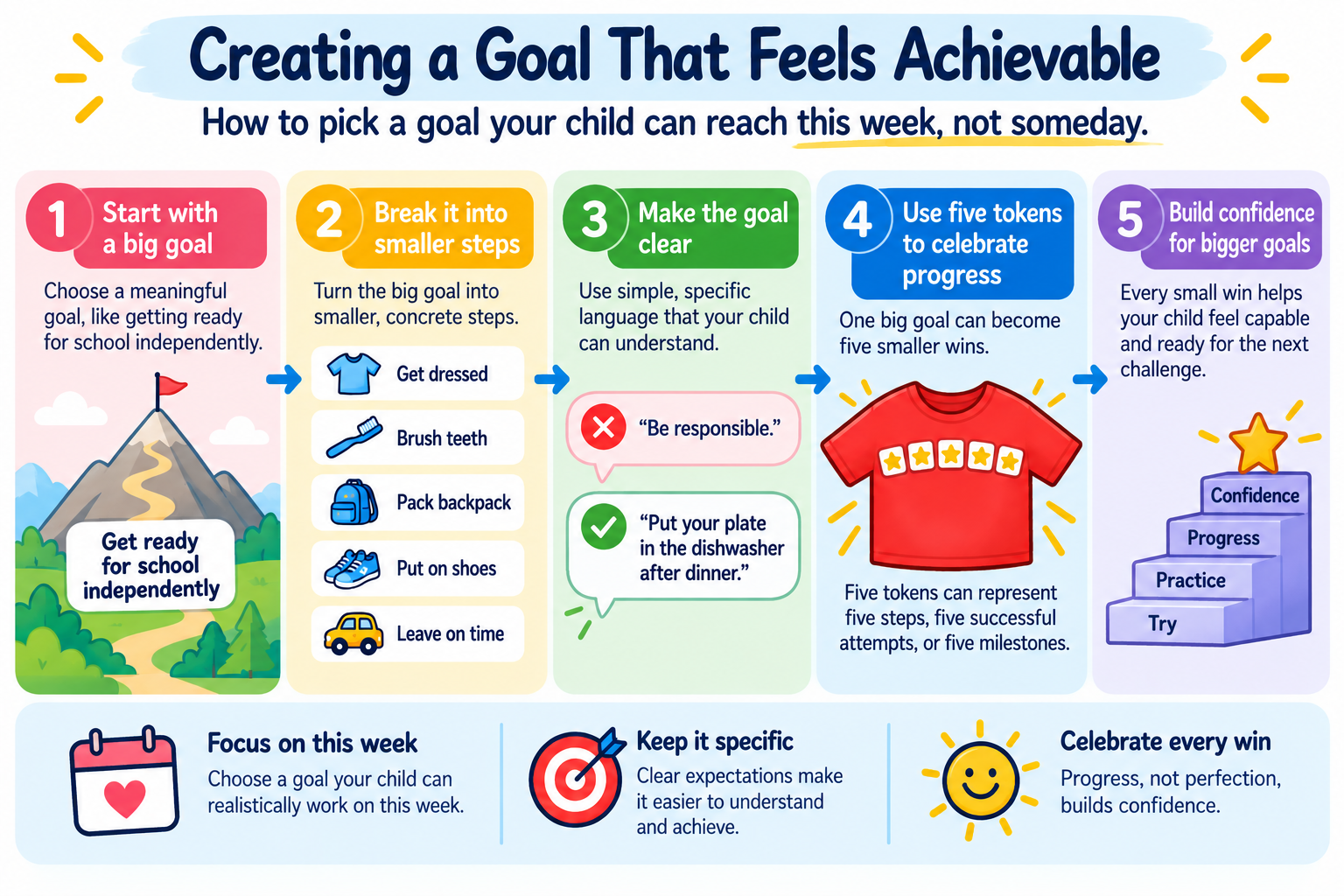
Take a goal such as "get ready for school independently." There may actually be several smaller skills inside it:
1. Get dressed.
2. Brush teeth.
3. Comb hair.
4. Put the backpack on.
5. Put on shoes.
Each of these can become a smaller goal. Depending on the child, even one of these may need to be broken down further.
For example, "get dressed" could become "put on shirt," then "put on pants," then "put dirty pajamas in the hamper."
The important question is not how many steps an adult thinks the task should have. It is how many steps the child needs in order for the expectation to feel clear and achievable.
Make the Goal Clear Enough for Your Child to Understand
A good goal should be observable. Your child should be able to understand what they are expected to do, and the adult should be able to recognize when the goal has been reached.
Compare these two goals:
"Be responsible."
"Put your plate in the dishwasher after dinner."
The first sounds positive, but it is vague. The second describes a specific action.
Clear expectations also make praise more meaningful. Instead of simply saying "Good job," you can say, "You put your plate away without a reminder. You earned your token."
Ask: Can My Child Reach This Goal This Week?
This is one of the most useful questions to ask before starting a reward system.
If your child succeeds almost every time, the goal may not be challenging enough.
If your child rarely succeeds, the goal may be too large, too difficult, or not clearly defined.
The sweet spot is somewhere in between: a goal that requires effort but gives the child a realistic opportunity to experience success.
That is especially important at the beginning. Early success can help a child understand that the system is predictable: I know what is expected, I can do it, and my effort is noticed.
Five Tokens. Five Smaller Wins.
Wear Your Wins shirts have five token spaces, which creates a simple visual way to break a larger goal into smaller wins.
Five tokens do not have to mean five completely different steps. They could represent five successful attempts, five completed parts of a routine, or five milestones on the way toward a larger goal.
For example, if the larger goal is improving the morning routine, you might start with one specific behaviour: getting dressed independently.
Break it down into smaller steps and each successful task earns one token. After five wins, the child can see something that was previously abstract: "I did it, I completed my five steps."
That visual progress can make the next step feel more achievable.
The five-token format is a framework, not a rule. If your child needs smaller steps, make the steps smaller. If five wins happen quickly, you can introduce the next part of the routine.
What If the Goal Still Feels Too Big?
Shrink it again.
If "brush your teeth independently" is still too difficult, perhaps the first goal is simply "pick up the toothbrush and put toothpaste on it."
Once that becomes comfortable, add the next step.
This is not moving backward. It is building the skill at the level where the child is ready to succeed.
A goal can also be temporarily adjusted when circumstances change. Travel, illness, school breaks, changes in routine, or a difficult week can all affect how much a child can manage.
Let Your Child See the Progress
One of the most powerful parts of a small goal is that progress becomes visible.
A child may not be able to look back and remember every successful morning, completed chore, or attempt at a new skill. A visual system gives them something concrete to point to.
The token becomes more than a reward. It becomes a visible record of effort.
This is one reason visual supports can be useful for many children, not only children with developmental differences. Wear Your Wins T-shirts is a reward system that makes an invisible process easier to understand.
A Special Consideration for Autistic and ADHD Children
For autistic children and children with ADHD, breaking a large expectation into smaller, clearly defined steps can be particularly useful.
A child may understand the overall expectation but struggle with the sequence, transitions, working memory, attention, or uncertainty about what comes next.
A smaller goal can reduce that uncertainty.
For example, instead of "get ready for school," a visual sequence might focus on one step at a time: get dressed, brush teeth, backpack, shoes.
The same principle applies to rewards. If the child is struggling to reach a five-token goal, the adult can change what earns each token rather than assuming the child is not motivated.
For children with autism or ADHD, it can also be helpful to coordinate goals with the strategies already being used at home, school, or with the child's support team.
Celebrate Progress — Not Just the Finish Line
The purpose of a goal system is not simply to get a child to the final destination.
It is to help the child experience the smaller moments that lead there.
A child who earns a token for putting on their shoes independently is practicing more than putting on shoes. They are experiencing effort, success, recognition, and progress.
Those small experiences add up.
Choose One Goal This Week
You do not need a perfect long-term plan to get started.
Choose one thing your child is close to being able to do. Make the expectation specific. Break it into smaller steps if necessary. Decide what counts as a win, and give your child a visible way to see that progress.
Then give it a week.
If it works, build from there. If it does not, make the goal smaller.
The goal is not to ask a child to reach "someday." The goal is to give them a win they can reach this week.
Every big achievement starts with a step that feels possible.
Watch: How to Help Your Child Reach Big Goals—One Small Win at a Time ⭐
Ready to try it at home?
A starter kit includes a shirt and a full set of reward tokens.
Shop starter kits